Kennel Club Assured Breeder to Best Practice
With the closing of the Kennel Club Assured Breeders scheme (ABS) comes a new standard from the Kennel Club. Interestingly I thought that all Kennel Club Assured Breeders would be meeting the new standards, but it seems not. To me the new standards are far lower than the expected requirements of the ABS. The Kennel Club have placed to practices that registered litters will be marked on, Good and Best. We will follow Best Practice with all our litters.
When looking for a new puppy on the Kennel Club website, you will find they are ordered in standard practice.
Watch out though – check both mum and dad have best practice. Not many do!
All my pups are Best Practice from both mum and dad. It is not a hard to obtain these DNA tests (saliva and blood generally) and it is responsible that prove our puppys’ parents are tested for known heredity diseases.
It is also good practice to re-test the DNA of breeding dogs every two generations, so don’t just look for Best Practice, check if a test was actually done or how far back in the generations the test was done, we cant rely on hereditary clear on both sides for too many generations.
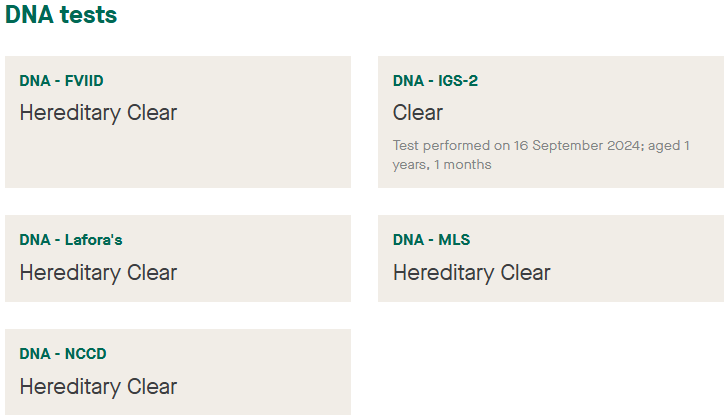
Here you will see Chivas Whisky is hereditary clear for a number of her tests and clear (the test was performed) for IGS-2. Looking down you will see why I decided to test specially for IGS-2 prior to breeding.
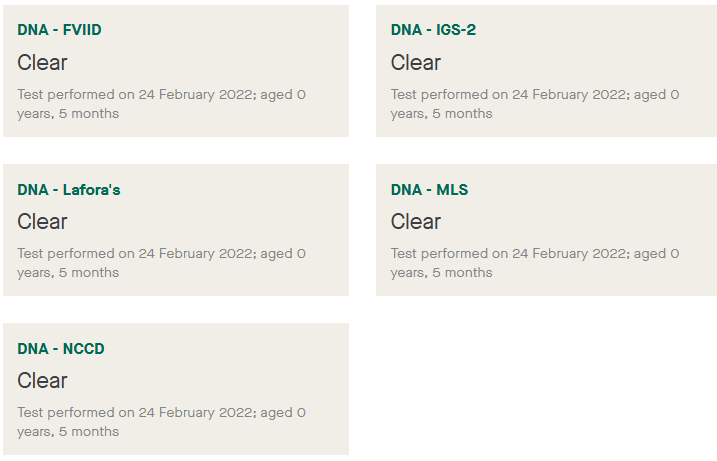
When we look back at the mum (Ziva) we can see she had her full tests done, We know that as she is clear no pups will be affected, but we still need to look at dad.
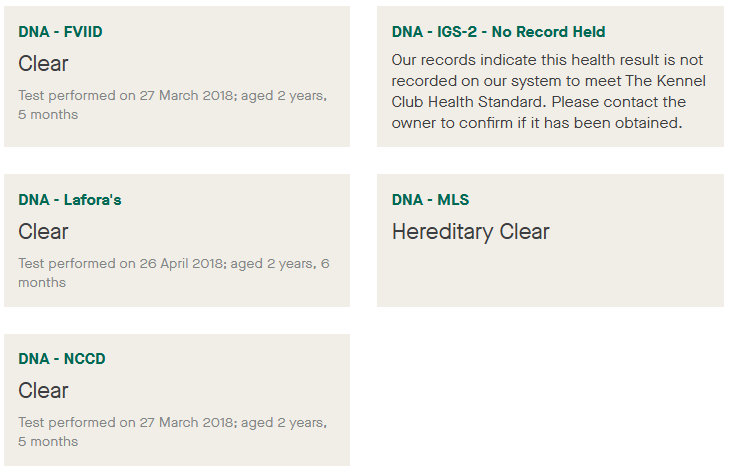
Here dad doesn’t have the IGS – 2 (this is a newer test and he is now older) – and you can see why we retested for IGS with Whisky. Any of Whisky’s pups we decide to breed from will need their MLS DNA test performing as this dad was hereditary clear from his parents, giving me the two generation gap where I prefer to retest.
Good Practice schemes and tests
We strongly recommend that breeders, at a minimum, conduct these tests before breeding, as evidence indicates these conditions are a significant concern in the breed.
- DNA test for Lafora’s – Find a lists of tested dogs here
- DNA test for Neonatal cerebellar cortical degeneration (NCCD) – Find a lists of tested dogs here
Best Practice schemes and tests
These tests address conditions that are still significant for the breed, though they may not be as critical as those listed under Good Practice. They might be less common or newly identified, and research is ongoing to determine their full impact.
To support the breed’s health, responsible breeders should ensure they complete all tests in both categories. Following our Best Practice guidelines means completing both the Good Practice and Best Practice tests for your breed.
- DNA test for Factor 7 deficiency (FVIID) – Find a lists of tested dogs here
- DNA test for Imerslund-Gräsbeck syndrome (IGS-2) – Find a lists of tested dogs here
- DNA test for Musladin-Lueke syndrome (MLS) – Find a lists of tested dogs here